How Terminal Skateshop Became an Uptown Skate Destination From a Sixth-Floor Walk-up
For over 20 years, Eugene Kang’s skateshop has served the community–from the sixth-floor of his walk-up apartment building
“If you’re coming through, you better make sure you help grandma carry her groceries,” Eugene Kang says. Terminal Skateshop, which Kang runs from his home, is on the sixth floor of his walk-up apartment building in Washington Heights. He wants to make sure skaters remember their manners as they climb the stairs for skateboards and gear in his shop.
Kang has operated Terminal from his apartment for over 20 years, but he doesn’t like to commemorate the exact date for the same reason he doesn’t like celebrating his birthday: it’s just another moment; what could it matter? Or, as Kang says, “I just don’t care about that shit.” But to a neighborhood that’s seen skate shops come and go for the last two decades, to exist for so long is a triumph, whether or not Kang wants to admit it. Generations of skaters from Washington Heights and the Bronx have now passed through Terminal, according to skater Bryan Espinal, who’s also a friend of Kang’s.
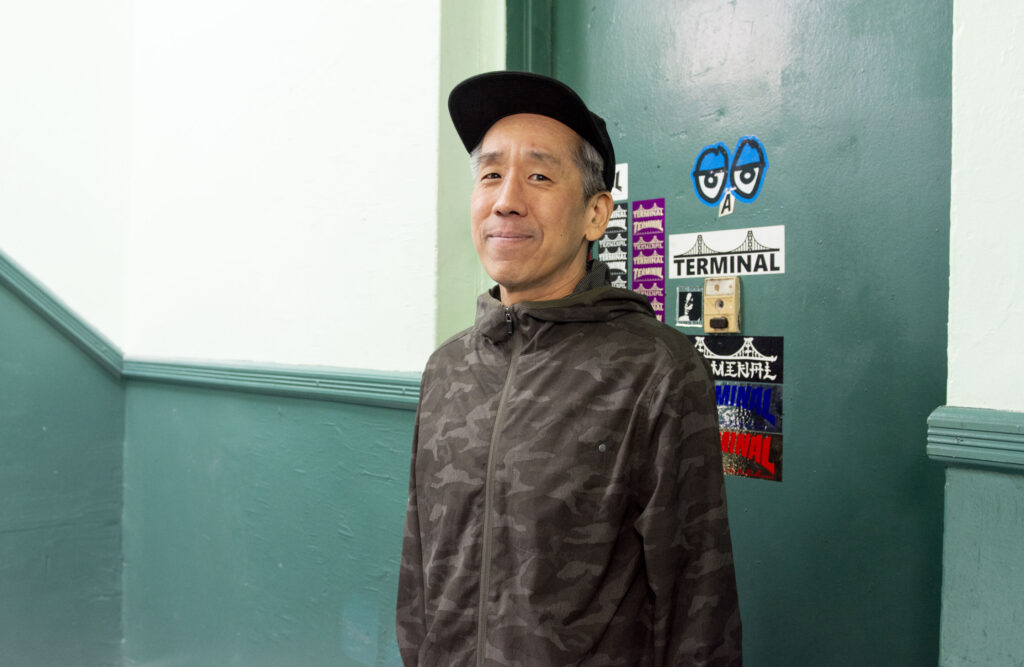
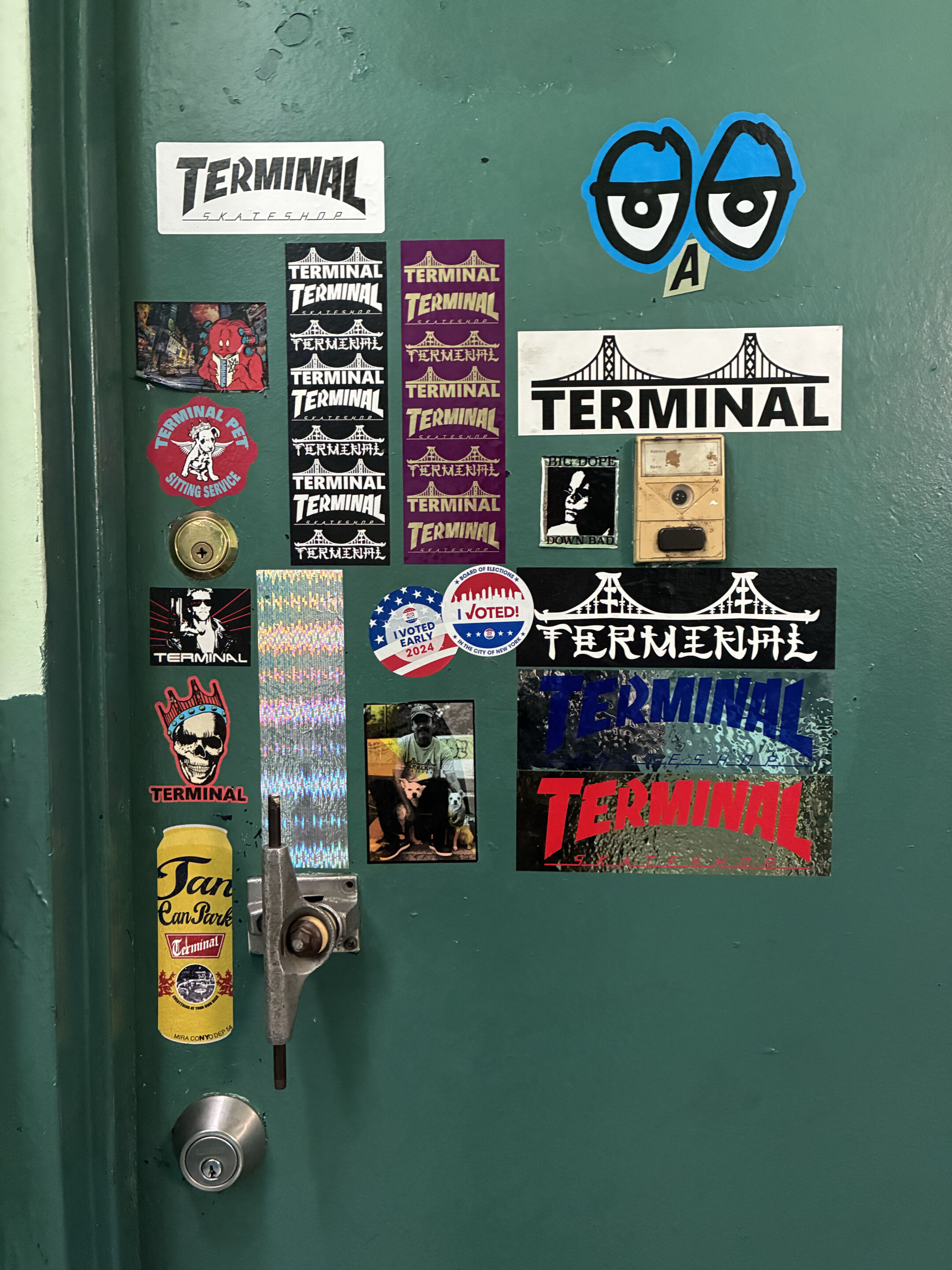
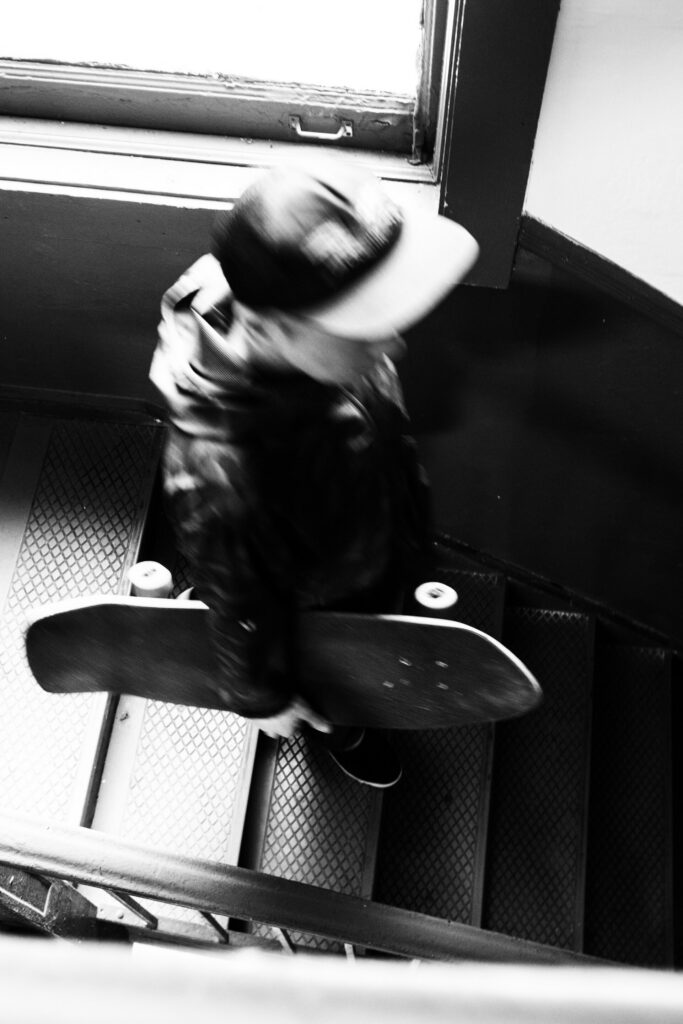
Climbing those stairs isn’t easy. You have to want what’s at the top. And if your other option is schlepping to skate shops downtown, you’re gonna make the trek. I start to feel it in my legs around the fourth floor, watching swaths of emerald paint edge their way along the walls. And no, I can’t imagine carrying groceries up there without help. But eventually, I get to the top, greeted by a collection of rectangular stickers that signal I’m in the right place. Terminal, each of them says, in a variety of colors and fonts and skulls and pictures of Arnold Schwarzenegger as the Terminator.
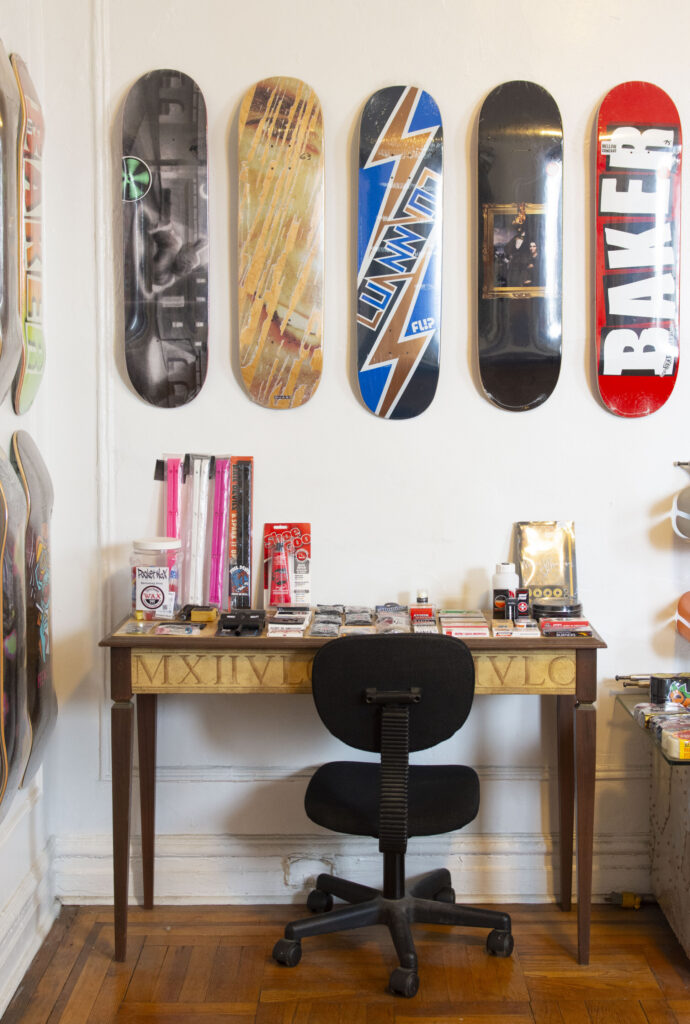
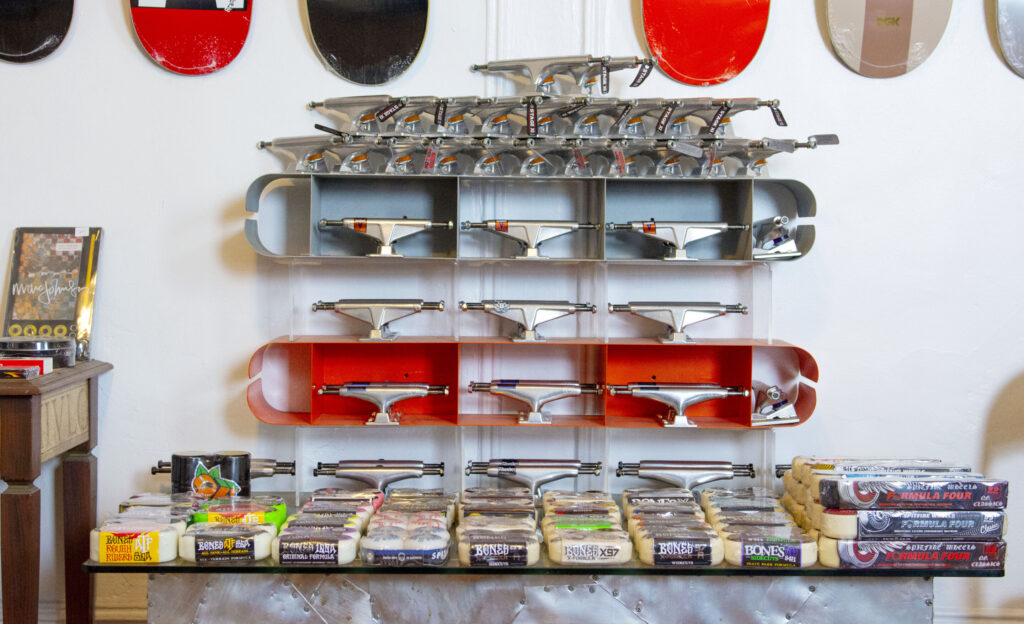
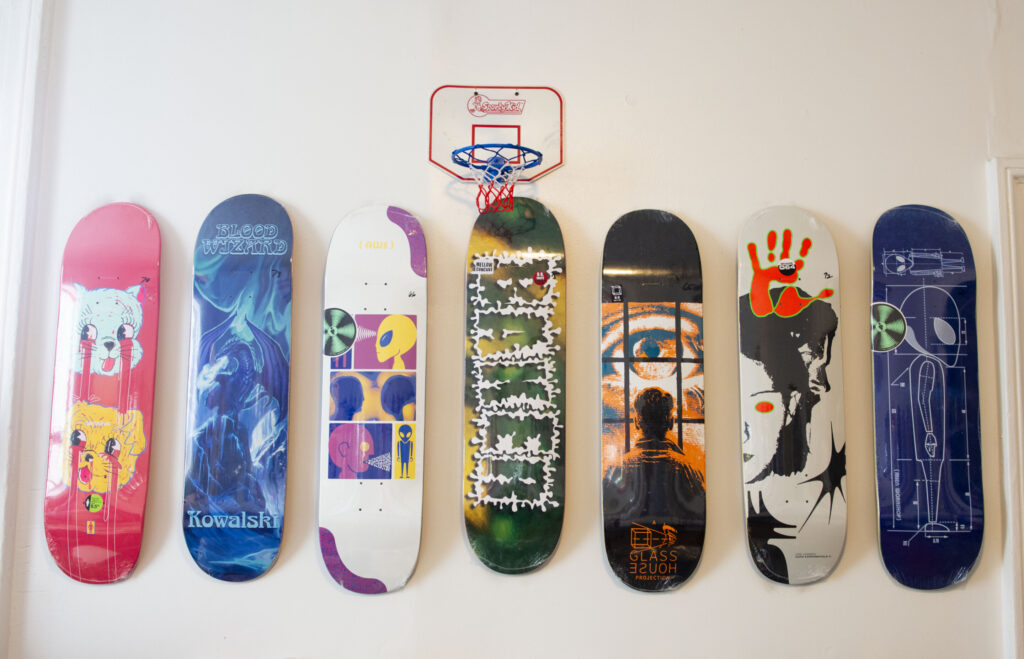
Originally, what became Terminal was just meant as a place for Kang’s friends when he noticed other shops were up-charging for skateboards. Pro skateboarder and Kang’s longtime friend Danny Supa once rode for Zoo York, and the brand gave Kang a box of boards for him and his close friends. At one point, there was just a pile of skateboards in a corner of his apartment. Friends would come and crash and go. Eventually, Kang says, what’s now the shop took on a life of its own, and he opened up to everyone else. He started hanging up the boards on the walls because he thought it looked nicer. He’d continue selling boards at lower rates than local shops. It grew from there–when I visit, he’s got Flip, Baker, 5Boro, Antihero, and Real skateboards on the wall, among many others, in addition to Dais and Thrasher merch, and more–including his own Terminal Skateshop shirts. He still gives out free grip tape with every board purchase; this used to be standard practice in skateshops, but it’s a rare occurrence these days. Kang prefers to have everyone skating, so he’s down to sell everything for a little less, he says. And no, he doesn’t carry sneakers–he can’t stand a hypebeast–so definitely don’t ask.
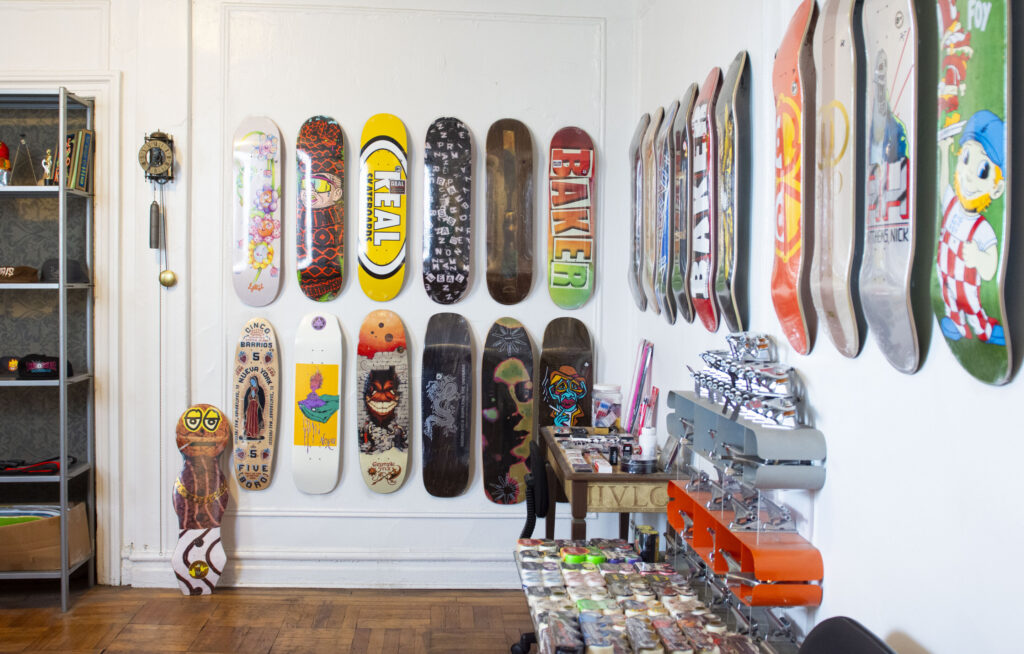
Skate stickers line the window and table in the massive front room of Kang’s apartment that serves as the shop. Skate art hangs on the walls, along with a painting of a pack of Newport cigarettes by the door. You can visit anytime, as long as Kang is conscious; as he writes on his Instagram, “Open when I wake up til I fall asleep. Closed when I’m skating. Don’t check IG often so call/text.” And he lists his phone number right there. So all you have to do is call or text, but don’t be a dick about it. He doesn’t want your phone calls at 2am asking “if he’s really open.”
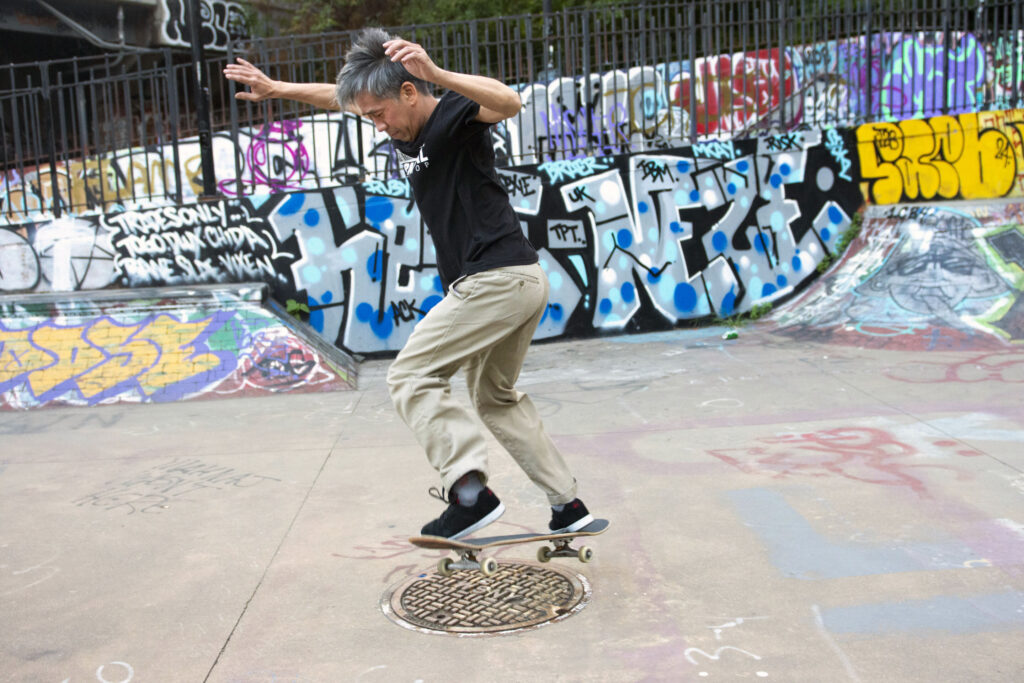
Kang never actually wanted to advertise the store–it was partially that he didn’t want random strangers in his apartment, and partially that he didn’t want people “asking for free shit”–and wanted people to arrive organically, by word of mouth. For a long time they did. But someone listed it on Google about three years ago, and purposely with the wrong address. “It was probably some hater just trying to be like, ‘oh, this guy’s closed,’” Kang says, but he started getting calls and again, one thing led to another. He fixed the address, and while he does get strangers showing up, more often than not it’s people who genuinely need a board–people who work late but want to skate, and tell him when they’re coming–and Kang will stay up for them. Kang still won’t tell skaters he meets right away about the shop, and hardly promotes it on Instagram. Often other people at the skate park–Kang’s preferred venue is the Hamilton Bridge Skate Park, simply called “181” for its proximity to W. 181st Street–will tell someone who will tell someone, and they’ll point out Eugene, skating at the park, as the guy with a shop close by.
Because at his core, Eugene Kang just loves skateboarding. From the time he first saw a skateboard, ridden by Michael J. Fox’s Marty McFly in Back to the Future, he knew it was something he wanted to do. He’s been skating on and off for over 40 years, though these days it’s mostly on. On a nice day, he often doesn’t want to sit inside; he just wants to skate. He’ll head to the park, returning to the shop if he gets a call or text from a skater in need. “If I don’t answer I’m busy or I’m skating,” Kang says.
Terminal Skateshop was named after a beloved former skate spot also called Terminal, after the George Washington Bridge bus terminal that was nearby. “It was a strip of fucking street,” Kang says–he says “fuck” a lot, in a classic, endearingly old school New York kind of way; he was born in Korea and raised in Brooklyn–on Fort Washington Avenue between 178th and 179th Street. It was under an overpass, so it was always protected from inclement weather or radiating sun. But the spot was covered up around the time of the bus terminal’s years-long renovation, which began in 2013 and ended in 2017. Uptown skaters–some of whom grew up skating there–couldn’t skate there anymore. The Hamilton Bridge Skate Park opened up, (at least partly) filling its shoes in 2013–Kang and many others who grew up skating Terms, as it was known, still prefer the original spot.
Even so, Kang has since become the park’s unofficial “mayor.” The mayor is “the guy who kind of regulates a certain skate park or the dude who has always been there, been there the longest, makes sure everyone cleans up and stays out of trouble and stuff like that,” says Doogie, a former pro skateboarder who met Eugene in 2008 as a teenager. “Eugene was that guy,” at J. Hood Wright Park, another park in the Heights, and now at 181, Doogie continues. “Gene’s always there. Everyone knows him.” And if someone breaks their board, they have a place to go to get a new one.
While there was a culture of skating uptown many years ago, a majority of the skaters in the community eventually made their way downtown by the time Kang arrived in 1998 or ‘99. Alex Corporan was among them. Corporan is a skateboarding industry veteran–a skater, historian, and event manager– who began skateboarding in Washington Heights in the late 1980s and was one of Supreme’s original staff. He’s known Eugene for over 25 years. Around the time Eugene opened Terminal, Corporan’s mother was even asking him why he didn’t open a shop himself.
“We didn’t have no skate shops back in the day, in the 80s, in the 90s, and even early 2000s. And then 181 Skate Park and Eugene pretty much coined being the mayor of Washington Heights skateboarding and 181 Skate Park. That is his,” Corporan says. “He’s a true skateboarder.”
Before the skate park at 181 was completed, Kang began bringing different skate obstacles to J. Hood Wright Park–he had approached the director of the park’s recreation center about storing them at the park. The director at the time not only agreed, but was all for it, especially if it meant the under-18 crowd signed up for the rec center (and they did). Eventually Kang and a crew of guys brought in about 20 obstacles, and J. Hood, as it was called, became another place to skate in the mid to late 2000s. Being visible as a skateboarder at and around that park allowed skateboarding to be visible again in the neighborhood. More people wanted to skateboard. That it was also the time of Tony Hawk’s ProSkater video games and Jackass didn’t hurt, either.
Kang also previously threw contests at the park and taught skaters how to introduce themselves to brands in hopes of becoming professionally sponsored by them. Doogie was among them. Kang introduced him to the team behind 5Boro, a skateboard and clothing brand based here in New York, at some contests in the city, and he ended up joining their team and riding for them professionally for 10 years. “Skateboarding is a really great culture, and people like Eugene hold it together,” he says. “He kind of created a forum for us to have a culture and a community up there.”
“He’s an uptown legend,” Bryan Espinal says. “He’s just always been the most integral part of the skate scene…the community is thriving because there’s someone like that, someone who dedicates their time.” Espinal is from Washington Heights and met Kang as a teenager some 20 years ago. Even now, Espinal always calls Kang before he hits up the skate park. Espinal currently works in the skate industry, as the Assistant Manager at Palace Skateboards in downtown Manhattan, and has collaborated with Kang on skate events. “Eugene plays in several parts in pushing the skateboarding culture and just keeping things fun uptown,” Espinal says. “A lot of people might think Washington Heights is like a rough-around-the-edges-type neighborhood, so you wouldn’t expect there to be a skate shop in a person’s apartment…you’d expect it to be like, ‘oh, man, it’s kind of sketchy.’ But Eugene, everybody respects and knows him.” For newcomers, Kang often sends a video or pictures of the store before they show up so they know it’s the real deal. He never wants anyone to feel uncomfortable or unsafe, himself included.
And while Kang runs a skateboarding business–and his opinions about how skate shops should be run are as numerous and headstrong as they are precise–his passion for skateboarding is at its core. He believes that skateboarding businesses should always be run this way: not with the idea of making a buck at the forefront, but with the idea of preserving skateboarding culture as he knew it growing up.
“Skateboarding, it’s literally just about fucking skateboarding. It’s about getting fucking tricks and dying and getting back up and trying it again, being fucking persistent, wanting to get it. It’s not about making money and a lot of these guys are chasing the money,” Kang says, adding that a lot of people start skating now with the sole motivation of going pro. “That’s not why I started skating, that’s not why a lot of people started skating. It was just like something to get the fuck out of the house and be this kind of fucking outlaw and that’s kind of gone away.”
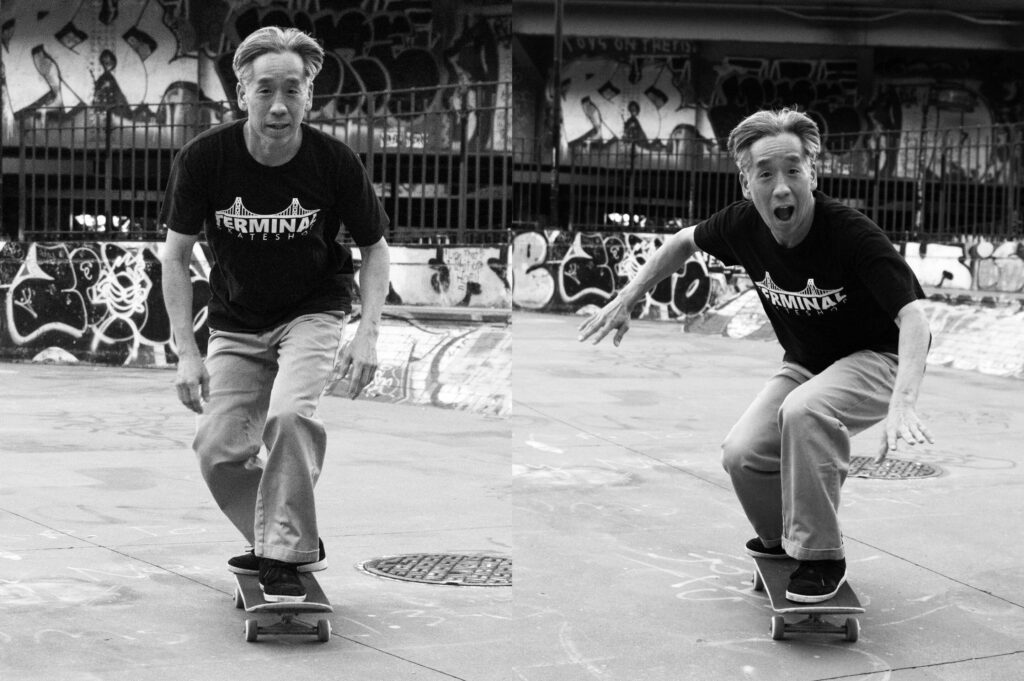
While skateboarding is comparatively mainstream today–it’s now in the Olympics, after all, and Tony Hawk is a household name–when people like Kang and Corporan started skateboarding, it was the polar opposite. Skateboarding in the ‘70s, ‘80s, and ‘90s made you a misfit, outlaw, or both. “You [were] absolutely hated if you were skateboarding,” Kang says, by everyone from jocks to cops to property owners of any stripe. There was a time when you had to do it because you loved it, not because it could lead anywhere. Because it often didn’t.
That culture was about making it work, DIY, having a group of people to connect with who loved skating so much they were often willing to get in trouble just to do it at all. Kang helps make it possible for the skate community uptown to keep connecting with a shared passion and even a shared history by having the shop itself, yes, but also by passing on the lore and connecting skaters to brands.
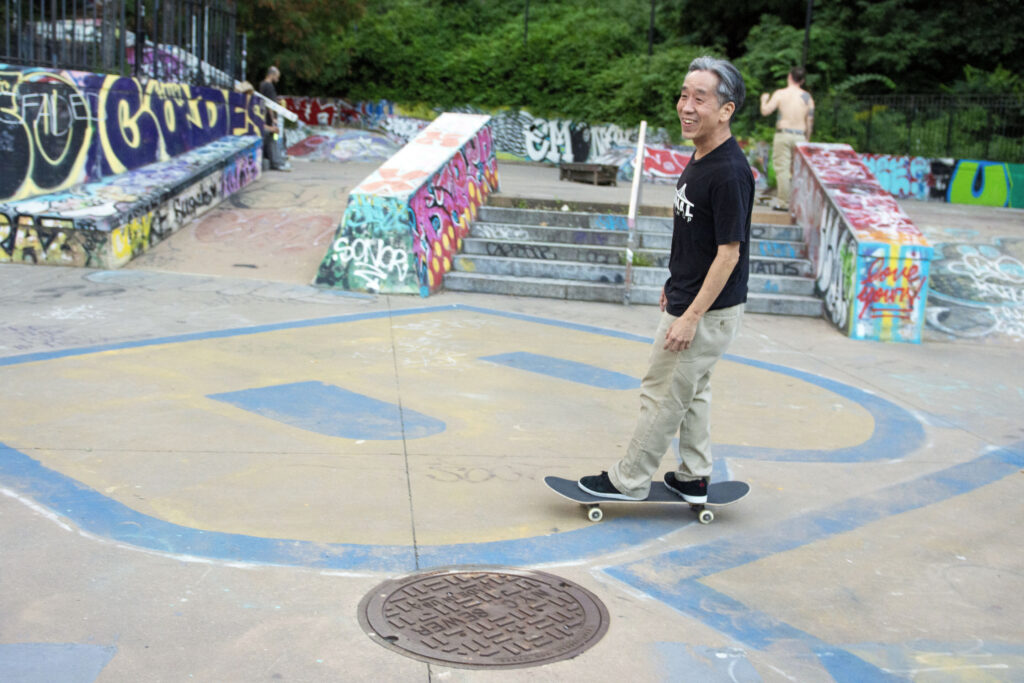
“You go to him and you’re gonna get stories, and you’re gonna bond with him. I just feel like it’s more of a homie-type skate shop and attitude than other places I’ve been where people might not want to make that connection,” Espinal says. Too many places just want to take your money and get you out of the store, he adds, but Terminal isn’t like that.
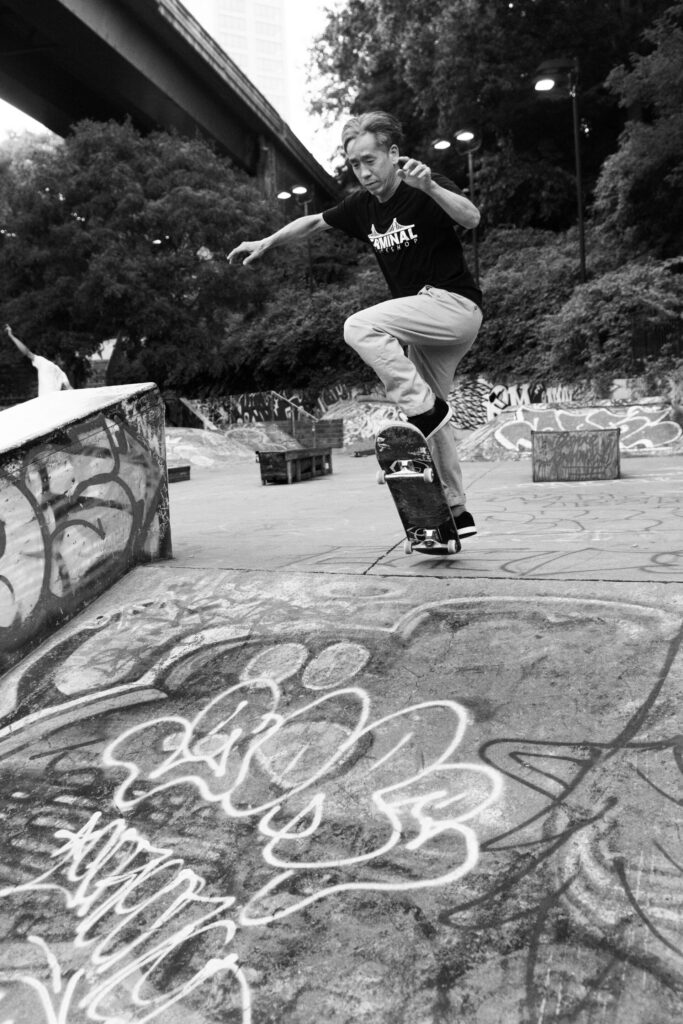
Kang does indeed have stories for days–when I visit him, we chat for 2.5 hours–about skateboarding, owning a successful gift shop business in midtown, the various side hustles and background acting gigs he’s had over the years, and even just about the items in the shop. Owning Terminal is his primary business focus these days, and he prefers it that way. In his gift shop days, he was unhappy and overworked. “All I cared about was money…and then I jumped on a skateboard. And I was like, dude, I forgot how much fun this was. What the fuck was I doing?” he says. “All that fucking money did nothing for me. It didn’t make me happy.” Since then, some 25 years later, he’s been skating regularly. “He really brings the energy that we used to do back in the day, and he brings the power. He has this golden energy, and everyone wants to be around him,” Corporan says, not to mention Kang’s skills as “a monster skateboarder.”
“His commitment to the culture is definitely a breath of fresh air that everybody likes to see,” Espinal says. “We’re all getting older and a lot of people quit, so just knowing that at least there’s one constant thing you can count on, and then that’s Terminal.” And yes, it’s Terminal, but it’s also just Kang himself.
Discover More