Maybe you heard it on the radio. Maybe you’ve been a fan since “True Romance.” Or maybe it was the moment Kamala Harris was declared “Brat.” However you found it, the sixth studio album by British singer Charli xcx didn’t just dominate music, it overtook culture itself, coating much of 2024 in an off-shade of green and a stripped-back, Arial typeface.
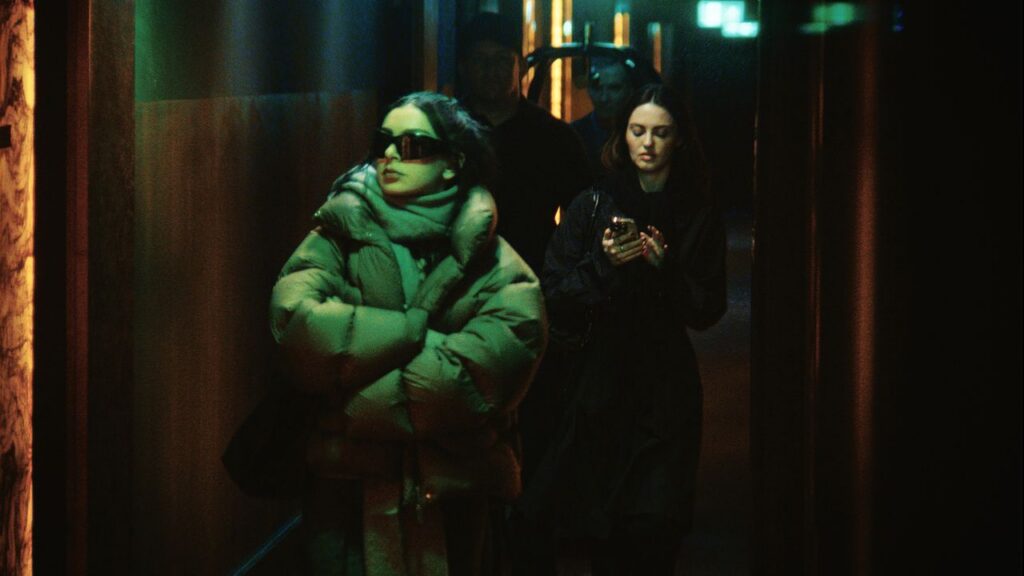
Well, here we are, nearly two years later, and Charli has remained at the forefront of our tongues. However, she isn’t just meekly riding the coattails of her previous success. Instead, she’s built an entire cinematic universe around her unrivaled conquest with The Moment: a voice memo–turned–mockumentary exploring the highs and lows of success. Directed by Aidan Zamiri and co-written with Bertie Brandes from an original idea by Charli herself, the film traces her rise from the underground scene to Madison Square Garden. Zamiri offers audiences a grossly glamorous peek into the truths of modern music’s capitalistic nature, capturing the cultural shift that defined the Brat era.
Zamiri, a Glasgow-born photographer and filmmaker, works at the intersection of fashion, music, and contemporary pop culture. Known for his bold, cinematic visuals and sharp sense of nostalgia, his most notable projects include Charli’s star-studded “360” music video and the movie-making masterclass “Birds of Feather” by Billie Eilish.
While attending the Sundance Film Festival—now in its 40th year and taking its final bow in Park City, Utah—we sat down with Zamiri to discuss what inspired the visual language and storytelling behind The Moment.
VMAN: I told the team we need to do something around The Moment—it was filmed so quickly, and it’s coming out so soon.
Aidan Zamiri: Yeah, exactly. It’s been this kind of really condensed timeline of making it, which feels quite brat, you know what I mean?
VMAN: Well, I saw it at Sundance. How did it feel to have your first feature film debut at a big festival?
AZ: I mean, it was so… straight. I have to say, though, I was kind of levitating outside of my body throughout most of it. The feeling was so surreal, and I am obviously so grateful, and we just had such a really fun, warm cast. But also, everyone looked smoking hot. It was so cool to have everyone there together. We didn’t expect such a massive turnout from everyone, and they just backed it so much. They were all so hyped about the film—it was such a moment. And the fact that it snowed as we were walking in felt really cinematic and weirdly thematic.
VMAN: It did!
AZ: Brat winter, rather than summer. But obviously, I’d never seen the film with that many people. The only times I have ever seen it with other people were with a handful of friends at various stages of the edit, so that was kind of bonkers. To answer your question, I think the only way to survive something like that is to kind of disassociate slightly. Regardless, I enjoyed seeing the audience’s responses and emotions.
VMAN: The audience was amazing.
AZ: A lot of the humor is really British, and a lot of it is in a very specific tone. You never know how it’s going to play in different rooms, yet it was so warm in that room. People really loved it. It was electrifying. Charli and I turned to each other halfway through and were like, “This is great!”
VMAN: The film has such a distinctive tone, pace, and energy. What did you want the audience to feel when watching it?
AZ: More than anything, we’ve obviously made something about something that’s very specific: a specific album, a specific moment in time. We’ve spoken about it being a kind of 2024 period piece, and it is obviously about Charli. But really, I hope that it touches on something that is kind of true—and also, in some ways, universal—something that everyone can feel like they can relate to. Anyone who works in fashion or advertising will have an immediate connection.
VMAN: I was fully anxious.
AZ: Exactly. Writing it was weirdly cathartic. It was stuff that I’ve experienced constantly, and even outside of the creative industry, it touches on what it feels like to be a person in a world where so much of our sense of self-worth is often placed on something outside of oneself. Whether it’s your job, your art, relationships, or anything you don’t have control over, you invest so much of your personhood into something that isn’t yours and isn’t you.
Hopefully, in that way, everyone will be able to relate to it and feel understood in some way. Even if all of it fails and everyone hates it, you’ve still got you, in some ways, at the end of it.
VMAN: What I saw was the brat of it all running away from her due to all these people trying to capitalize off of it. There’s this central tension in the movie where she feels like she’s losing control over her brand, which, as we now know, branding is such a big part of this project in general. Now that your own star is rising, what changes have you kind of seen from the people around you?
AZ: I have the good fortune that so much of my work decentralizes me, where I work with a lot of people who are so front and center in the things they put out. Whether they’re actors or musicians, they are often the focus, and that speaks to what’s happening in the film: your sense of identity can get really muddled up with that. And don’t get me wrong, my sense of identity is very much muddled up with my work, but at least it’s not me as a body. In some ways, that’s helpful, but it’s still such a personal thing. Anytime you make anything, you’re sharing a piece of your life or a part of your worldview.
You’re saying, “This is what I find beautiful, this is what I find emotional, or this is what has meaning to me.” Sometimes that really strikes a chord with people; sometimes people really get it, and sometimes they won’t. When the latter happens, you’ve got to stay in the mindset of, “I made this because I had to.” If people love it and connect to it, that’s amazing. And if they don’t, that’s also fine.
VMAN: What were some films or cultural media that you drew from?
AZ: There’s obviously a lot of British comedy influence in there. Speaking of, I was so stoked that we got Jamie Dimitri in this film. I don’t know if you’ve ever seen Stath Lets Flats, but it’s brilliant. Any British friends I have who’ve seen it are like, “Oh my god—Jamie is in this film!”
There are a lot of British comedy influences overall, like Armando Iannucci, he’s an amazing filmmaker who does dialogue really well. He also writes characters that are both believable and absurd.
We do quite a combination of genres without really trying to. The way I approach work—whether it’s a photo, a music video, or a film—is to think about the aesthetic, visual, and sonic choices that help get the point across. I even think about it in terms of the medium we’re working in. For example, when trying to communicate this idea, I had to ask, “Is a movie the right place for it to live? Or is a music video the right place?” So every choice we made stylistically was always in service of getting the message to hit home as much as possible.
There are parts of the film that feel edited like a horror movie, and there are other parts that are, you know, straight-up jokes. In that way, it kind of undulates between being heightened, funny, and surreal, and then becoming really grounded and emotional. I love Black Swan. I think it’s an amazing film, and it’s funny how, thematically, though it wasn’t the intention at the beginning, I watched Black Swan again and thought, weirdly, we’re hitting a lot of similar points with this film.
VMAN: There was that scene after she sees Kylie, and she goes in the mirror, and I was like, whoa.
AZ: That’s the glass. I was like, “Whoa,” too. I didn’t even realize what we were doing. In the lead-up to a big performance, a woman kind of loses her sense of identity, goes a bit mad, and becomes a new version of herself, you know? It’s an incredible film that plays with anxiety and tension the whole way through.
I was really happy to hear that a lot of people felt triggered and anxious throughout the film. That was amazing to hear. I’d seen someone write that it was kind of Spice World meets Uncut Gems, which might be the biggest compliment I could ever receive in my life, because it really does feel like that’s how I like to operate in every facet of my work.
Having a combination of different pockets of culture—stuff that feels zeitgeist-y, stuff that feels specific and weird and niche—and then whacking those things together.
VMAN: Speaking of the different parts of culture, in terms of the cast, you need someone in fashion, or someone who knows the industry, to recognize all those people, but then there was also this mix of mass appeal. So how did the casting process work?
AZ: The cast is the reason I am so in love with this film, because I’m so in love with them. Jen Vendetti, our casting director—she’s an incredible, Oscar-nominated casting director—has such an intelligent way of thinking about media and movies, and about how things don’t exist in a vacuum. She’s aware of the fact that if you see someone, you bring associations with them, especially if they’re a known person. Or even in the way they act, and the instincts they have as a human being, if that crosses over with their character, it makes for such a better performance. Jen often casts people with that in mind. Obviously, she’s done a lot of work where she has real people from real places of work performing those same kinds of roles in films, even if they’re heightened versions of themselves, or even if they’re playing characters that aren’t exactly what they would do in real life. For example, someone like Mel Ottenberg.
It was incredible to have him in there, because Mel understands the fashion world, he understands celebrity styling. He didn’t need to study or do research for that character, because he’s had a lifetime of research for it. He knew all the weird, passive-aggressive elements of that space. He was able to invent all this history he would have had with Charli.
And similarly, Hayley Benton Gates is such an incredible director, and she cares so deeply about art and integrity. Her instincts as a person, as Hayley, are very similar to Celeste’s instincts as a character in the film. What I love about Jen is that she understands people are the audience that makes those associations. It’s also why I think it’s really interesting that we’ve got people like Rachel and Kylie in this film, because we already have our own relationships with them, and we understand what that is.
This film works like that. We have so much reference to the real world, so much strange crossover, and this blurring of fiction and reality. That’s the kind of thing I love and the kind of art that I like.
VMAN: That’s one of my favorite scenes, when Rachel comes on and she’s talking about the video and the approvals. That’s where I’m like, they just nailed so many real things. Even if you’re not an insider and you don’t know how this works, there’s still something else you can take away from the movie.
AZ: That’s the hope. Hopefully, if you get a reference, it enriches the experience, but even without it, we’re touching on something that’s human and real. I think it’s a Lorne Michaels quote or something like that, which is so funny. He has a line that’s like, “Reward people for knowing, don’t punish them for not.” So it’s about telling a story that everyone can connect to, because it’s a human experience, while also having fun with references.
Zoolander did that amazingly—films that acknowledge the world around us. I think a lot of the movies we grew up with in the 2000s did that really well. You’ve got things like Scary Movie; it’s in conversation with the culture around us, like meme culture, in a lot of ways. It’s not ignoring the culture at large; it’s speaking to it and incorporating it into the storytelling.
VMAN: Charli’s core base is so engaged with online discourse, and they’ll know all these people, so I do think it makes sense for someone like her, who’s very engaged constantly with the culture. Obviously, you’ve done music videos, commercials, and viral social content. But what’s been your favorite part about doing this film?
AZ: I guess the biggest difference is the scale; it’s obviously way longer and way bigger. Even though that’s daunting, there’s something really cool about it, because you get to dig into it in such a thorough way. I’d often been almost envious of my musician friends who are able to tuck themselves away and write an album.
Musicians can work on something, polish it, dig into ideas and themes, throw away things that don’t contribute to that theme, and add things in that do. So it was very cool to have that space, even if it was on a really condensed timeline. Still, having this kind of time and space to dig into something in a fuller, more thorough way was special.
It’s like we used this real-world phenomenon, we used Charli, as a way to talk about something Charli feels really passionate about, something I feel really passionate about, and something Versi, my co-writer, feels really passionate about. It was about getting across a small piece of our worldview.
VMAN: I just have one more question. I was doing my research in between screenings, and I know you studied set design at CSM?
AZ: I studied graphic design at St. Martin’s, but I helped a lot by assisting with set design.
VMAN: How involved were you in that part of the process? Because of your background?
AZ: I’m glad I’ve had that experience, because it’s helped me in every part of my career. Being able to see image-making or filmmaking from a lot of different points of view. When I first started making videos, I didn’t realize you could actually outsource anything. I didn’t know you could get a different editor, a different sound designer, any of those things. So when I first started making stuff, I just did all of it myself, because I didn’t know collaborators were an option.
Now I’m really grateful to have people with way more expertise than me. Because I have an understanding of most parts of the process—I understand how fashion works, how production design works, editing, sound, all of those things—I can speak to them. I can speak the language of it. I feel like I’ve got some of that technical understanding, and I can communicate properly with people and give them the information that helps them do their job properly.
Being a photographer isn’t just about explaining something properly; it’s about communicating properly, whether that shows up in the final product or in the entire process leading up to it. It definitely helps that I have a fairly holistic approach and a holistic view of making things in general. I can speak to some of the more technical or practical aspects, and that also supports the more abstract, holistic vision, hopefully.
VMAN: You see it, because the movie plays like it’s a complete picture.
AZ: I’m really into how all these different elements help tell part of a story, and I think that’s partly because of my background in photo and music video, where you don’t always have the luxury of communicating an idea through words. You’ve got to get an idea, and emotions, across through images, and we connect to those images and references. That’s why I feel like the color, the sound, and the graphics all contribute to the story I’m telling.
VMAN: I’m so excited to see it again because now I can pay attention. It almost moves too quickly. As I was watching, I knew I needed to see this again.
AZ: It’s something that you want to watch 3 or 4 times, I would say. That’s not a tactic of me being like, buy loads of tickets!
Discover More