Read the Room: How Eliot Glazer Became a ‘Terrible, Horrible, No Good, Very Bad Gay’

In his debut essay collection, the longtime screenwriter combines humor, heart, and a pinch of self-deprecation
The first time I learned about Eliot Glazer’s debut essay collection, The Terrible, Horrible, No Good, Very Bad Gay, out now, I realized how long his work had punctuated different parts of my life. When I was in college, his Tumblr (!) My Parents Were Awesome was regular viewing (it was later turned into a book). After I graduated, we met once in New York through a mutual friend hosting a comedy show (and another time in Bloomingdale’s). As I settled into adulthood, I became a devoted fan of Broad City, for which he was an actor, writer, and consulting producer; and Younger and New Girl, where he was a writer and story editor. With the release of The Terrible, Horrible, No Good, Very Bad Gay, we chat as I’m three months into my new job as Associate Editor at V. Despite Glazer having a hand in crafting all of these cultural touchstones beloved not just by me but by countless others, it’s in reading this book that we actually get to learn about him as a person.
In The Terrible, Horrible, No Good, Very Bad Gay, Glazer examines his feelings of being an outsider, of not being “an Upstanding Model Gay Citizen,” throughout the course of his life. In prose vivid and raucous–I laughed out loud on the subway multiple times, devil may care–we’re with him cackling at CATS on Broadway as a Long Island teen; hating the high school drama teacher who kept trying to out him; celebrating with him as he finds a comfortable and accepting sex party; and reveling with him as he explores his own facets of queer joy.
It’s not easy to excavate your joys, let alone your neuroses, flaws, and struggles—especially on the page, while maintaining a comedic voice and knowing God knows how many people will eventually read it. And yet Glazer does it with aplomb. Here, he speaks to V about comedy, vulnerability, and what it means to fit in (or not).
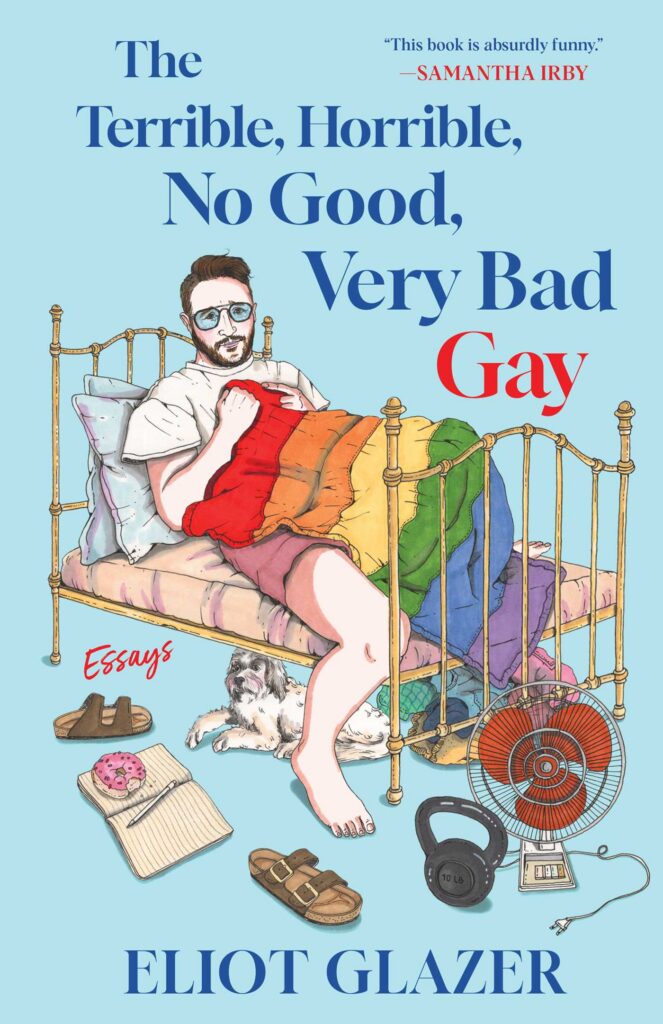
VMAN: What made you want to work on a book in the first place?
ELIOT GLAZER: Ultimately, it started because I collected all these stories and material that I poured into different TV projects, stand-up, and digital content, but putting it into a book long form made sense. It was a way to get everything out and to almost have a “bad gay” exorcism. It turned out to be even more cathartic than I could have imagined. At the same time, when the writers’ strike happened in the summer of 2023, my book agent was like, “Okay, let’s go.” So the timing worked out well, too.
VMAN: It’s noteworthy that the book doesn’t have a traditional happy ending, some unconditional self-acceptance message. What made you decide to do that?
EG: Writing the book, the process unfurled itself to validate that. Of course, being vulnerable is more powerful; leaning into authenticity is more relatable and appreciated by readers and consumers. I already know that from comedy and screenwriting. So why not apply it to a memoir? Honestly, the reason I did it is the reason I wrote something: because it’s how I feel. Nothing is guaranteed, but in my own experience, making mistakes, failing over and over again, and finding a room for acceptance–that is what let me get there as a queer person. I loved the idea of sharing that with at least one person who might need to get there, too. I also think there’s often a rainbow-washing to queer narratives where the idea is that once you come out, all your problems are solved. Life doesn’t work like that. In my experience, it was a matter of striking a balance between who I am as a person with who I am as a queer person. That’s essentially what got me to that point, an acceptance of nuance, mess, chaos, and the ultimate freedom of being my truest self without bells and whistles, everything being sparkly and precious.
VMAN: You’ve discussed your editor making sure you weren’t hiding behind jokes, that being vulnerable would be part of this process. What did it feel like to hear that when you first started writing? Now that it’s essential to the text, what did it feel like to be vulnerable while maintaining a comedic voice?
EG: The feedback I’ve appreciated the most is when somebody who’s read the book has said to me, it’s funny, but it also touched me; it was heartwarming and I got to see the real you. The instruction to be more vulnerable and to not wear jokes as armor was a rude awakening, but completely necessary. I so appreciate my editor for getting me there. At the same time, the process of excavating my interior life and forcing myself to be vulnerable was so deeply cathartic and painful, truly digging into the work I’ve done in therapy for over a decade. I even say, to a degree, my therapist wrote this book [laughs]. He’s the one who genuinely helped me come to terms with what I was tantruming about and railing against, finding a way to accept my own identity and my own limitations, taking a softer approach to myself and the world. But the process of getting there, emotionally speaking, was at moments excruciating. I wanted to take a break from myself; I’m with myself all day, and it’s enough. Ultimately, getting to do it in a long-form version couldn’t have been healthier. Forcing myself to get to that vulnerable place feels now, in retrospect, completely necessary. If I didn’t do that, the book would not be the same. No shame in a memoir that’s a machete of jokes and punchlines. I love that as much as the next person, but because the book is focused on finding and accepting queer identity, I couldn’t have done it without the instruction of being deeply vulnerable and taking a self-examining approach. Examining myself and my inner life gives me a unique perspective that I hope others can find funny and entertaining, if not useful.
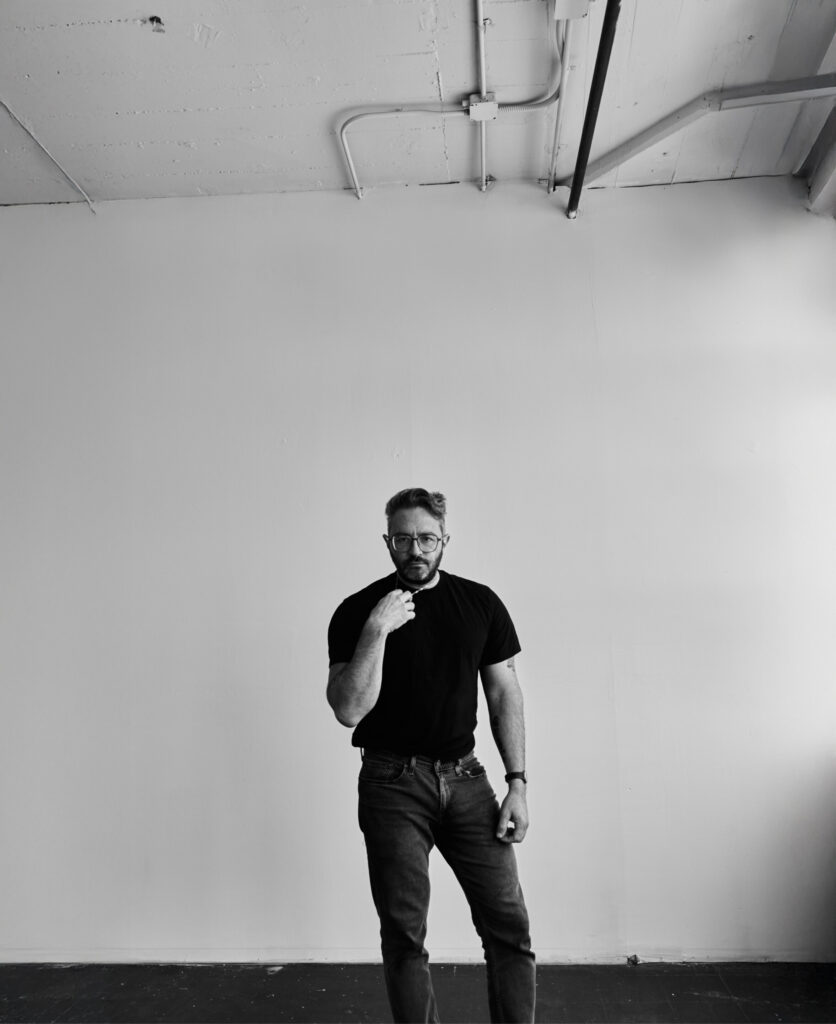
VMAN: After writing for the screen, how did you cultivate your own voice as a writer? How did working for the screen influence you?
EG: Being in a writer’s room is my cloud nine, my happy place. I love collaboration and I love working with other funny people. I thrive on writing dialogue for different characters, but my favorite type of character to write for is a confident idiot. Nobody has ever done it better than the 30 Rock team with Liz Lemon. Her character manages this balance: she’s not remotely an idiot, but she is a mess, who is in her own way vulnerable, but has a process of getting there. That was honestly the voice I channeled in the book. I knew what felt right for me was not to be pithy, super sarcastic, or caustic, but instead to engage my inner Liz Lemon, somebody who could criticize myself, but also have enough confidence to move through the world in a way that is still healthy, if not delusional. Unlike a writer’s room, this was essentially solitary confinement. I don’t think I could bear writing the book in the style that I wrote for–the last time I wrote in first person format was during the blogging era, 10-15, years ago, when pithy, caustic, and literary was the norm, from Gawker to my own blogs, and I say blogs with an S at the end. Plural. My Parents Were Awesome was a Tumblr that came on the cusp of Instagram. It hit this Venn diagram of nostalgia, photography, and internet culture right before BuzzFeed and Instagram hit. But I do think of it fondly because it not only got me a book deal, but it was a soft place to land on the internet that people seemed to enjoy. I didn’t want to be pithy with this book. Not because my voice has evolved in writers’ rooms, but because my inner voice has evolved as a person. It’s more fun to read a person who’s self-realized but a little delusional. I think I struck the right note because I never wanted to get to a place where your laugh was a book laugh, which is a smirk versus an actual laugh, an audible sensation.
VMAN: After having worked on the book, do you still think you’re a “terrible, horrible, no good, very bad gay”?
EG: I still think I’m a very bad gay in a lot of ways, but with the book all finished and in the throes of promoting it, the way it’s connected with people–so many early readers have talked to me about feeling seen and feeling a kinship there. I might be a moderately bad gay, not very bad. I still do it wrong, and I still feel like a weirdo a lot of the time. I think there are more of me out there than I initially assumed, because look, I know in a situation where I feel I’m doing gay wrong, there are other people who are absolutely in their heads, not feeling they fit in entirely. For better or worse, I have historically had to blurt out my discomfort, and I’ve been yearning for so long to meet other people who can mirror it, for my own selfish satisfaction and need for camaraderie. My hope is the book allows other people to recognize that in themselves and feel permission to say it out loud, too. If that makes me a moderately bad gay, then I’m all about it.
VMAN: It seems like writing about queer joy in the book was especially revelatory for you.
EG: I would say so. Honestly, my sister got me there. Initially, when she asked me, “Where do you harness your queer joy?” I was like, “That’s not a question. That’s not my question. I don’t even…It doesn’t speak my language.” But getting to a place where I could accept all the stuff from, I’ll call it homonormative culture, it does make me feel included. At one point, I was doing an interview a while back, and it was maybe a Jewish-themed podcast. The interviewer asked me if I celebrate Shabbat. I do celebrate Shabbat here and there with my family here in LA, and it’s a very low-key, wildly reform affair–eating BLTs–but it’s still almost a spiritual versus religious situation. It’s culturally Jewish more than anything. But I said I don’t celebrate Shabbat. She said something like, “Well, what do you do on Friday nights?” And I said, at the time, I was going to the same bar in LA every week to watch Drag Race with friends, and she was like, “Well, that is your Shabbat. You’re surrounded by people in your community, you feel safe, and you’re all there to do the same thing and be in the same place.” It changed my perspective and made me feel like, “Wow, this is queer joy.” Even if I’m in a sour mood, to be in that bar, see the same people every week, and know they’re around, Drag Race or not, felt genuinely communal in a way I’d never experienced.
VMAN: What are you working on now in addition to the book, and what are your wishes for the book’s life moving forward?
EG: I’m promoting the hell out of the book in every way I possibly can, through traditional means, but also in literally the most DIY, guerrilla style–stickers on lampposts and postcards to indie bookstores. Aside from that, I’m actually working on a completely different thing, which is an audio/video sports podcast, which is a complete 180. It indulges my love of the confident idiot in that I play an elevated version of myself, interviewing world-class athletes about sports. But my understanding of sports is barely elementary, almost to the point where I don’t even know how physics works. The questions are so insipid, and I’ve never loved writing anything more than this. In terms of the book, it would be so lovely to see my work pay off, being on a bestseller list of some kind, and making a name for itself on BookTok or whatever, all these booky, literary places. My biggest hope for the book is that it does organically seat itself in the community, and not just with queer people, but with anybody who feels like an outsider and wants to yell it from the rooftops. For queer people, I hope the book allows them to feel seen. Realistically, I hope it’s a hit. But I’d be as happy if the book managed to find word-of-mouth success because people just feel it, identify with it, find it funny. That it becomes a tool for self-acceptance for other people who may also feel they’re very bad at whatever group they’re supposed to fit into.
Discover More